
Development of Active Learning in Learning Management Subject
Date
2017Metadata
Show full item recordAbstract
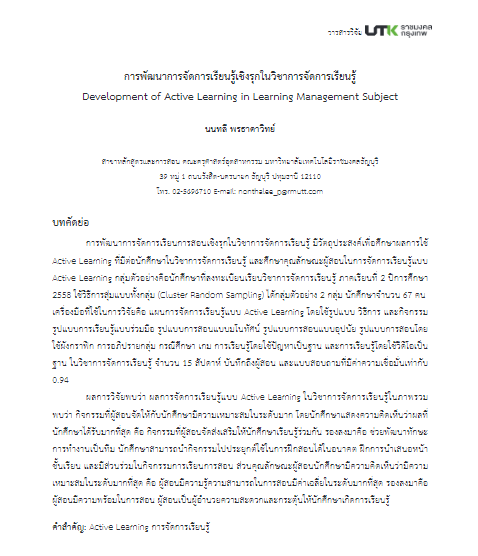
The development of active learning in learning management subject was aimed to examine the effects of active learning on students in the learning management subject and to evaluate the characteristics of instructors in the management of active learning. The sampleswere students who enrolled in the learning management subject in the second semester of academic year 2015. Cluster random sampling was employed to obtain 2 sample groups of 67 students. The research tools included an active learning management plan using the model, cooperative learning model, concept attainment model, inductive teaching and learning model, graphic organizer instructional model, group discussion, case study, game, problem base learning, and constructivist video instruction in the 15-week-learning management subject, memo to instructors, and a questionnaire with reliability of 0.94.
The result suggested the effects of active learning in the learning management subject in overall found that the activities arranged by instructors for students were appropriate at high level. Students reported the most pronounced effect of activities arranged
by instructors was on promoting collaborative learning, followed by enabling teamwork skills development, applying activities to students’ future professional training, practicing class oral presentation, and participating in teaching and learning activities. For the characteristics of instructors, students viewed them as appropriate at highest level, with highest level of mean for instructors’ teaching knowledge and competency, followed by instructors’ preparedness in teaching, and instructors as facilitator and stimulator of students’ learning.
URI
http://dspace.rmutk.ac.th/handle/123456789/2121https://www.tci-thaijo.org/index.php/rmutk/article/view/147090/108398