
Ethanol Production from Ripe Palmyra Palm Fruit Pulp Extract using Loog Pang Khao MaK and Loog Pang Satho
Abstract
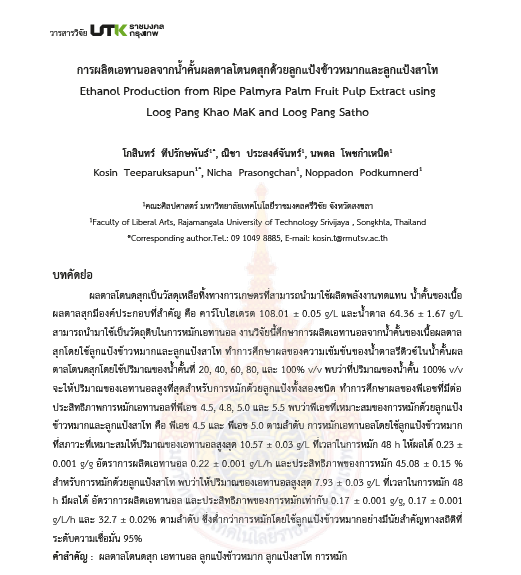
Ripe palmyra palm fruit is an agricultural residue that can be used to produce alternative energy. The fruit pulp extract contained carbohydrates (108.01 ± 0.05 g/L) and sugars (64.36 ± 1.67 g/L) which can be used as substrate for ethanol fermentation. This research investigated the production of ethanol from palmyra fruit pulp extract by using Loog Pang Khao Mak and Look Pang Satho. The effect of reducing sugar concentrations was studied by using fruit pulp extract at 20, 40, 60, 80, and 100% v/v. The result showed that 100% v/v of fruit pulp extract gave the highest ethanol concentrations for the fermentation with the two types of Loog Pang. The pH affecting the fermentation efficiency was investigated at 4.5, 4.8, 5.0 and 5.5. The optimum pH for the fermentation with Look Pang Khao Mak and Loog Pang Satho were 4.5 and 5.0, respectively. The fermentation with Look Pang Khao Mak at optimum condition gave the highest ethanol concentration at 10.57 ± 0.03 g/L with 48 h fermentation time. The ethanol yield was 0.23 ± 0.001 g/g. The productivity and fermentation efficiency were 0.22 ± 0.001 g/L/h and 45.08 ± 0.15 %. For the fermentation with Loog Pang Satho, the highest ethanol concentration was 7.93 ± 0.03 g/L with 48 h fermentation time. The ethanol yield, productivity and fermentation efficiency were 0.17 ± 0.001 g/g, 0.17 ± 0.001 g/L/h and 32.7 ± 0.02 %, respectively. These were significantly lower than the fermentation with Loog Pang Khao Mak when statistically tested at 95 % confidential level.
URI
http://dspace.rmutk.ac.th/handle/123456789/3163https://www.tci-thaijo.org/index.php/rmutk/article/view/166223/137504